
Best Countries to Retire: Where Uruguay Fits in 2026
A pension can be enough to qualify for one country’s residence route and still be the wrong kind of evidence for another. Savings, rental income and a pension payable for life are not interchangeable. That distinction matters more than a photograph of a beach.
For readers comparing the best countries to retire, we would start with five different residence models: Uruguay, Panama, Costa Rica, Portugal and Spain. Each belongs on this shortlist for a specific reason, from a published pension threshold to a route for people living on their own income. None wins every comparison.
This is a retirement-residency comparison, not a global ranking of healthcare, safety or living costs. The rules discussed were checked against the official sources linked below on 24 October 2026. Your nationality, household and intended work can change the answer.
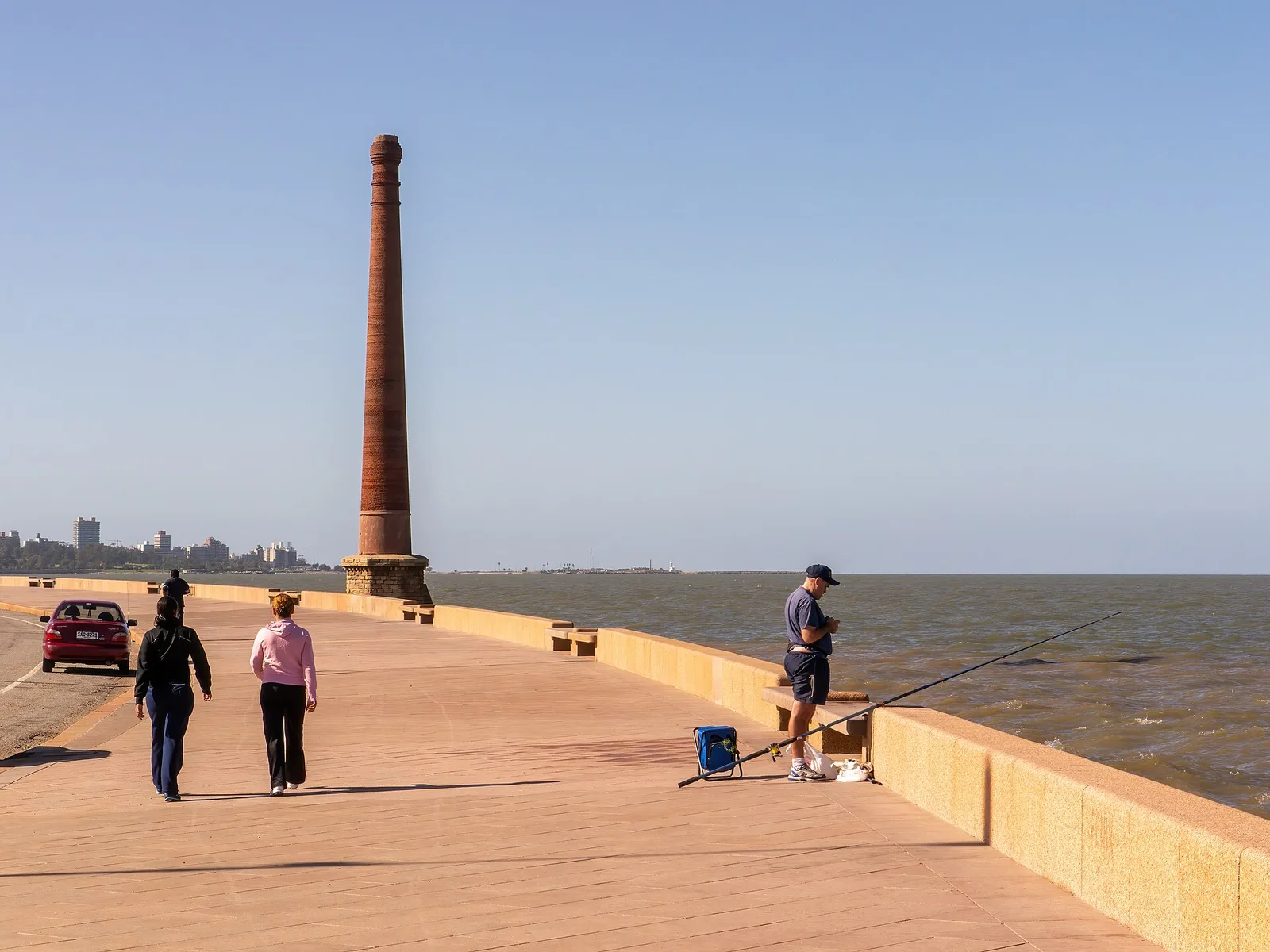
Cover: Montevideo’s Rambla, photographed in 2011 by Ermell, CC BY-SA 4.0. Resized and converted to WebP.

Best countries to retire: compare the residence route first
The amounts below describe immigration evidence, not a recommended monthly living budget. They do not include every fee, dependent or insurance requirement.
| Country | Route worth examining | Financial evidence to check | The limitation that can change your decision |
|---|---|---|---|
| Uruguay | The permanent residence category applicable to your nationality and circumstances | General-route guidance requires documented means of support; do not assume one advertised dollar figure applies to everyone. | Filing, an identity card and a final residence decision are different things. |
| Panama | Pensionado | Normally a lifetime pension of at least B/.1,000 a month; the official checklist adds B/.250 in monthly support per dependent. | An investment account is not automatically a qualifying lifetime pension. |
| Costa Rica | Pensionado or, separately, rentista | The law specifies at least US$1,000 a month in a stable foreign pension, or US$2,500 in qualifying monthly income for rentista. | These are temporary residence categories; insurance and renewal obligations need a separate budget. |
| Portugal | Residence visa for retirees and people living on their own income, commonly called D7 | Evidence of pension or other qualifying own income, together with the current consular requirements. | The entry visa and the subsequent residence permit are separate steps. |
| Spain | Non-lucrative residence visa | 400% of IPREM for the main applicant, plus 100% for each accompanying family member. | It is a non-working route; do not assume that overseas remote work is permitted. |
Panama: a defined pension test
Panama is worth an early eligibility check if you already receive a pension for life. Its official Pensionado checklist sets out the pension evidence and dependent support requirement. A private pension also needs supporting information about its provider.
The useful question is not simply whether your bank account receives B/.1,000 each month. It is whether you can document the qualifying pension in the form the authority accepts. A portfolio withdrawal strategy may fund your retirement comfortably without being the same legal evidence.
Do not confuse this with a property-led immigration application. Our Panama permanent residency guide discusses a different route; compare the actual category before committing money to a property.
Costa Rica: distinguish a pension from other income
Costa Rica’s Migration Law, Articles 79–82, separates pensionado from rentista. The former requires a permanent, stable foreign pension of at least US$1,000 monthly. The latter uses a US$2,500 monthly qualifying-income test.
Both sit within temporary residence. The law also addresses authorised paid activity and social-insurance evidence for renewal. Passing the income test does not settle those questions.
For a couple with mixed income, list each source separately before choosing the category. A pension, rents and investment distributions may need different supporting documents. Then obtain an insurance and renewal budget alongside the application quotation, rather than treating the statutory income minimum as the complete cost of moving.
Portugal: plan beyond the visa
Portugal’s official national-visa guidance includes retirees and people living on their own income. This is commonly discussed as D7. The consular application is one part of a move; the residence-permit stage in Portugal is another.
Ask which pension or other income records your consular post requires, how family members will be included, and what evidence must remain available after arrival. Avoid planning a property completion or removal shipment around an advertised visa-processing estimate.
Our independent-means residence guide provides wider context for comparing income-supported routes. A retirement visa and an investment residence programme should not be priced as if they were the same product.
Spain: a clearer fit for retirement than ongoing work
Spain’s official non-lucrative visa guidance uses 400% of IPREM for the applicant and another 100% per family member. The index, evidence and insurance requirements should be checked for the filing date and consular jurisdiction.
The important restriction is work. The cited consular guidance excludes gainful professional activity, including remote online work. Someone retiring fully and someone continuing to consult for overseas clients may therefore need different immigration advice, even with identical savings.
Before selecting Spain, write down what you will actually do after moving. Calling a payment a retirement supplement does not decide whether the activity producing it is compatible with this visa.
Uruguay: assess a residence category, not a retirement package
Uruguay deserves a closer look when the goal is to establish a home and document a sustainable means of support, rather than buy a residence product. The Interior Ministry’s explanation of residence categories distinguishes permanent, temporary and other permissions. There is no rule that every applicant must complete temporary residence first.
The general permanent route and the Mercosur route have different checklists. Family connections can also affect the category. A retiree should begin with nationality and the source of support, not an assumption that every overseas pensioner uses one universal retirement visa.
Retiring in Uruguay: what needs preparing before you travel?
The practical work starts outside Uruguay. Which countries must issue your records? Do the names match your passport? Will documents need an apostille, legalisation or translation? Ordering the wrong version can cost more time than the appointment itself.
Choose the correct residence checklist
For applicants using the general permanent residence procedure, the official requirements address identification, criminal-record evidence, vaccination certification and means of support. The criminal-record review includes the country of origin and relevant countries of residence during the preceding five years. The applicable age and residence-history conditions matter.
A pension certificate should explain the source and regularity of the income; a bank balance alone does not explain either. Where support comes from employment, a business or family, the evidential route needs checking for those circumstances. We would not treat an informal US$2,000-a-month rule found online as a universal legal threshold.
Eligible nationals should compare the separate permanent Mercosur residence checklist. A checklist chosen because it looks shorter can create problems if it is not the category you qualify for.
Prepare documents in the order they will be used
Uruguay’s current legal-residence instructions require attention to originals, authentication, translation and document validity. They also recognise certain verifiable electronic documents; an apostille should not be ordered mechanically for every file.
A useful preparation list is:
- Identity: check passport details against every civil record and appointment booking.
- Residence history: identify the criminal certificates required before requesting them.
- Family evidence: determine which marriage, birth or parental-consent documents the application needs.
- Authentication and language: confirm the apostille or legalisation route and any accepted translation requirements.
- Support and local requirements: prepare the income evidence and arrange the required health documentation.
Our birth-certificate apostille guide and marriage-certificate apostille guide explain the document-preparation questions. The receiving authority’s current requirements still determine the final file.
Do not apply a blanket six-month expiry to every record. Check each document and category. Applicants who do not speak Spanish must also arrange the interpreter required by the residence instructions.
Keep three administrative milestones separate
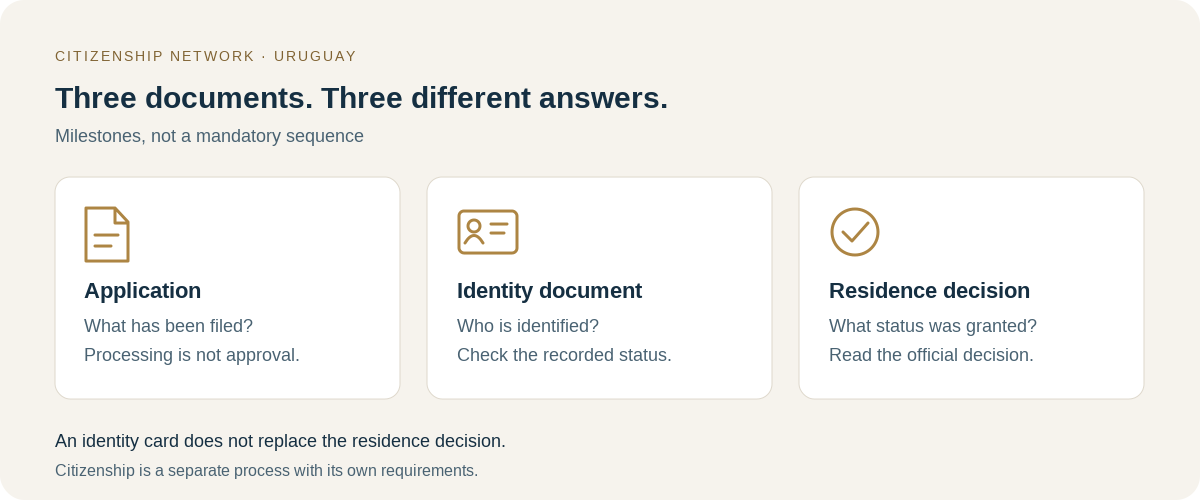
Uruguay’s identity-card procedure covers several immigration situations, including applications still in process. Receiving a cédula is therefore not, by itself, proof that permanent residence has been granted.
Track the file under three headings: what has been submitted, what status the identity document records, and what decision the migration authority has made. These are not promised steps on a seven-day schedule. An appointment confirmation should not become a guaranteed approval date in your travel plans.
Choose the retirement location with a real household budget
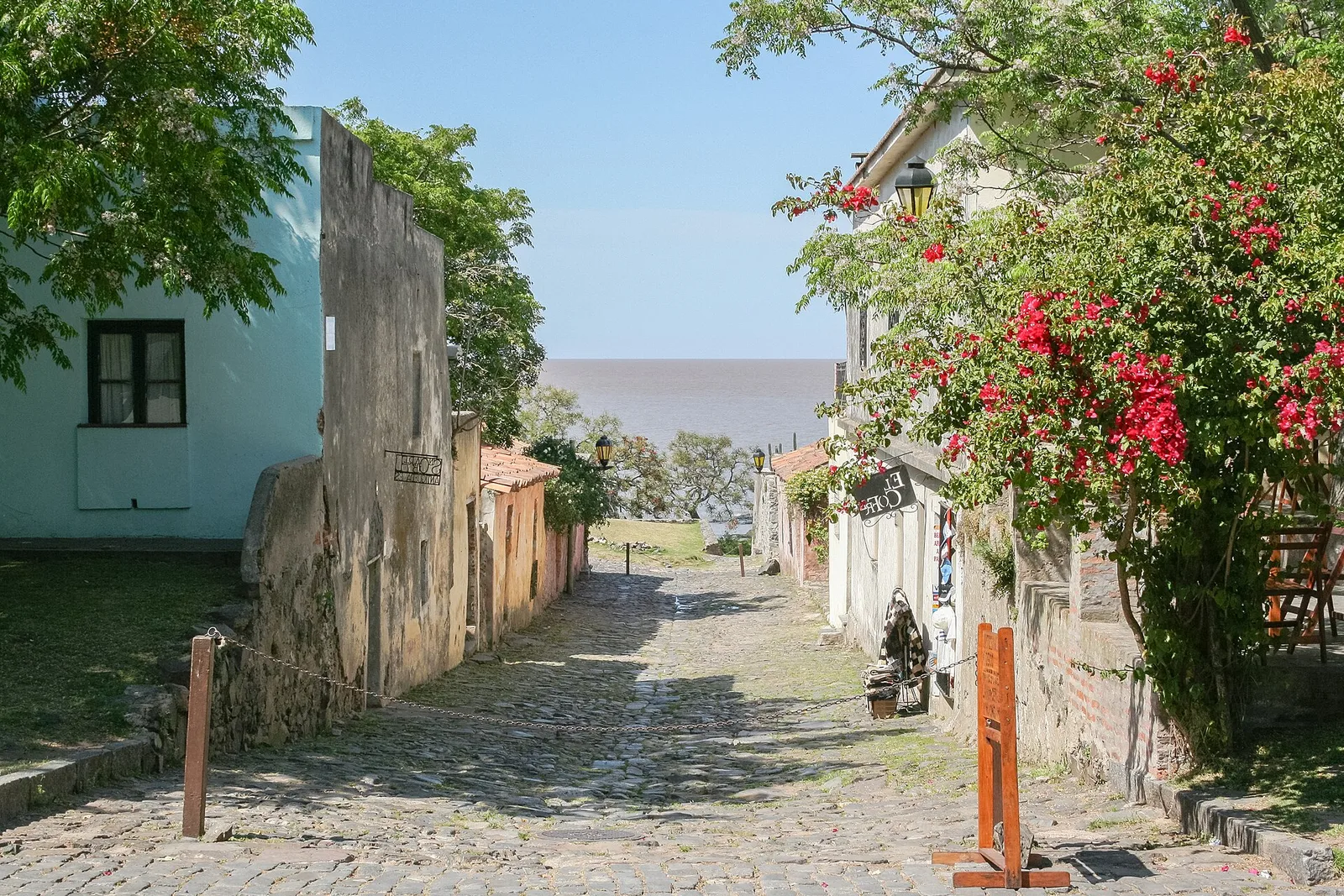
Colonia del Sacramento. Photo: Diego Delso, CC BY-SA 3.0. Resized and converted to WebP.

A residence checklist can tell you whether a file is possible. It cannot tell you whether a particular neighbourhood works for your retirement.
Before choosing between Montevideo, Colonia or another location, price a normal month there: a suitable rental, utilities, groceries, transport, medication, insurance and the healthcare access you actually need. Add return flights and a currency buffer. Use written quotations where possible; a national average is a weak substitute for the home and medical arrangements you would use.
For each country on the shortlist, answer the same practical questions. How far would you be from your family? Could you manage appointments in the local language? Would a partner be comfortable there independently? Could you afford a change in exchange rates without selling assets at the wrong moment?
We would rent before making an irreversible housing decision where the immigration and financial plan allows it. A pleasant visit tests the destination. A longer stay tests the routine.
Travel, tax and citizenship need separate decisions
While a Uruguay residence application is pending, the re-entry procedure requires attention before leaving and returning. The official guidance provides for a permit for each applicable trip. Discuss travel dates before booking an appointment and assuming you can disappear until approval.
Permanent residence also should not be treated as a status with no absence risk. Article 47 of Uruguay’s Migration Law allows cancellation in specified circumstances, including absence exceeding three years. That is different from saying it automatically expires on the third anniversary.
Tax residence is a separate question. The tax authority’s residence tests include presence exceeding 183 days in a calendar year, alongside other grounds. A residence application does not itself settle your tax position. Our Uruguay tax residency guide examines that part of the planning.
Citizenship is separate again. The Electoral Court’s citizenship guidance distinguishes three years of habitual residence with a family established in Uruguay from five years without one, subject to further requirements. It is not simply a married-versus-single test. Its guidance also addresses Spanish ability and absences exceeding six consecutive months, which can restart the required residence period.
A residence card is not a promise of a passport three years later. If citizenship matters, check whether your actual living pattern can support the application, not just whether you can obtain the first document.
How we would narrow your shortlist
Start with three facts: who is moving, how the household will be supported, and where you intend to spend the year. Then compare the evidence needed for the route with the life you intend to lead.
For a Uruguay enquiry, tell us your nationality, family members, current country of residence, income sources and intended move date. Include whether you expect to keep working or travel frequently. Do not send sensitive identity documents through an initial general enquiry.
Citizenship Network provides Uruguay residence application support. We can assess the applicable route and the document work before you organise the move. Discuss your Uruguay residence plans with us and ask for a scope of work that separates document preparation, application assistance and government decisions. Approval and completion dates remain with the authorities.
Questions about retirement residency
Which are the best countries to retire for someone with a pension?
Panama and Costa Rica have pension-based residence categories with published income thresholds. Portugal and Spain have routes for people supported by their own funds, while Uruguay assesses the evidence required for its applicable residence category. The right choice depends on your pension, family, intended presence and tax position.
Can you apply directly for permanent residency in Uruguay?
Yes, if you qualify for an applicable permanent residence category. Uruguay does not require every applicant to complete a temporary residence stage first. Nationality, family connections and the supporting evidence determine which category to assess.
Does a Uruguayan identity card mean permanent residence has been approved?
Not necessarily. Uruguay has identity-document procedures for several immigration situations, including residence applications still in process. Check the status recorded and the residence decision rather than assuming that possession of a card proves permanent approval.
Does moving to Uruguay make you a tax resident automatically?
No. Immigration residence and tax residence use separate tests. Uruguay’s tax authority lists physical presence, vital interests, economic interests and specified investment conditions among the relevant grounds. Review your circumstances before deciding when to move income or assets.