
Consular Protection: Which Second Passport Backs You Abroad
Every passport ranking sells the same number: how many countries let you in without a visa. Nobody publishes the number that matters on the worst day of a trip. When your wallet vanishes in a foreign city, when local police hold you overnight, when a hospital admits you after a crash, or when an airport closes mid-coup, the question is no longer where your passport can take you. It is who comes for you.
That help is called consular protection, and the gap between passports on this measure is wider than any visa-free score suggests. At Citizenship Network we find most clients have never weighed it at all, which is a mistake, because one type of citizenship treats protection as a legal right while every other treats it as a favour.
The baseline every country works from
The floor is set by the Vienna Convention on Consular Relations of 1963, which almost every state applies. Its fifth article describes the job: replacing lost travel documents, standing by nationals hurt by crime or accident, supporting families after a death overseas, and organising help when disaster or war breaks out. Article 36 adds the clause that matters most in a police station: a detained foreigner may contact their consulate, and the consulate may visit.
What the convention does not do is oblige anyone to help. Britain’s official guidance says outright that there is no legal right to consular assistance. Australia’s charter repeats the point almost word for word, and Canada frames everything as services it may provide. Discretion is the global norm.
Bigger networks, better odds
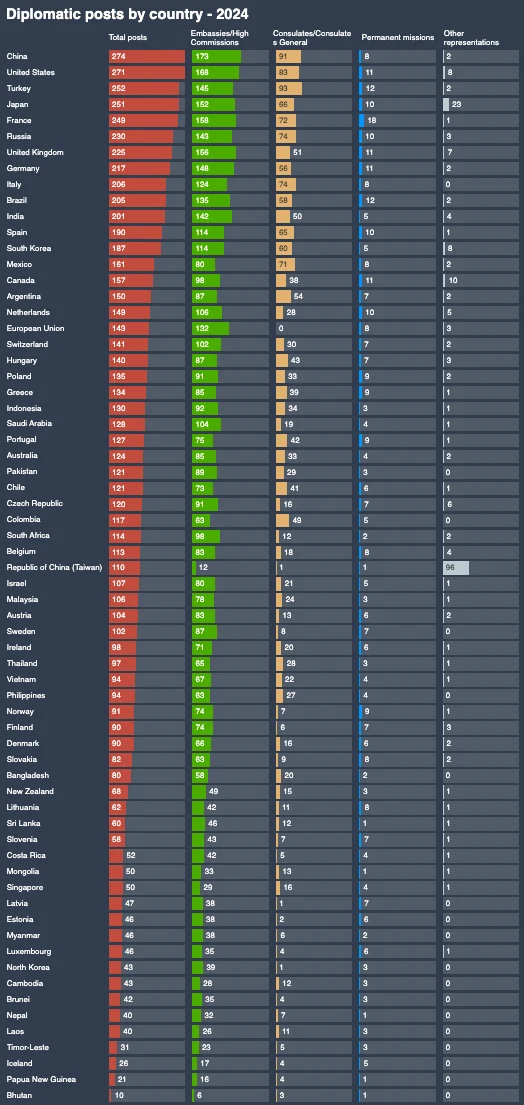
Help requires a nearby mission, so network size is the first filter. The 2024 global diplomacy figures put China first with 274 posts and the United States just behind at 271. The surprise in third place is Türkiye, with 252 posts, ahead of Japan and France, while Russia’s network has shrunk during its war on Ukraine.
Türkiye deserves a longer look here, because its diplomatic expansion has run alongside a deliberate opening to foreign residents and investors. A Turkish passport now sits above most European nationalities for raw consular reach, and Ankara has paired that with strong economic incentives: the new twenty-year tax exemption on foreign income under Law No. 7582 is the boldest of them, which our sister publication covered in detail in its report on the Turkish foreign income exemption. For investors weighing protection, reach and cost together, Türkiye’s citizenship by investment programme is one of the few that scores well on all three.
Still, counting posts only measures presence. It says nothing about how hard a mission will work for you, and on that point the law matters more than the map.
The one passport where help is a right
The European Union stands alone here. Its founding treaties, backed by the Charter of Fundamental Rights and a 2015 directive, give every EU citizen an enforceable entitlement: in any country outside the EU where your own state has no embassy, you may walk into the mission of any other member state and receive the same protection its own citizens get.
Hold an Irish or Portuguese passport and you effectively carry a claim on twenty-seven consular networks at once. Family members from outside the EU who travel with you are covered too. The system has been tested at scale: during the pandemic, member states coordinated to repatriate more than 600,000 stranded Europeans, and since December 2025 an EU Emergency Travel Document replaces lost passports where your own country keeps no mission.
Britain demonstrated the price of leaving. UK citizens lost the pooled right at Brexit, keeping a large but discretionary national service and losing twenty-six other doors.
Two caveats keep this honest. The directive guarantees equal treatment, not one uniform standard, so the service you get depends on whose mission you reach. And the right belongs to citizens only. A golden visa, however long you hold it, carries no consular entitlement; since Malta’s programme was struck down by the European court in April 2025 and repealed that July, no member state sells citizenship directly, so the EU right now comes through residence followed by naturalisation, or through ancestry. Our guide to citizenship by descent covers the fastest of those paths, and our Portugal routes overview maps the main naturalisation track. The broader logic of pairing an EU permit with a second passport is set out in our Caribbean and EU strategy piece.
Getting people out is a different skill
Evacuation rewards logistics, not embassy counts. When Sudan collapsed in 2023, the United States, Britain, France, Germany, China and India all flew their people out, several carrying other countries’ citizens as well. India is the quiet leader in this discipline despite its mid-sized network: the 1990 Kuwait airlift moved roughly 170,000 people and is still cited as the largest civilian air evacuation, with Yemen in 2015 and Sudan in 2023 continuing the record.
For EU citizens, evacuation runs through their own capital first and the shared framework second. That works when a big member state takes the lead, and it is thinner for citizens of small states without airlift of their own, which is exactly what the pending revision of the EU rules aims to fix.
The rule dual citizens learn too late
One limit binds every passport, and it surprises people constantly: no country can protect you inside the other country that claims you as a citizen. Britain will not normally intervene for a dual national in their second homeland. Australia promises only exceptional-circumstances help there, and Washington warns its consuls may simply be refused access.
The detention of a British-Iranian mother in Tehran from 2016 to 2022 showed how absolute this is: because Iran rejects dual nationality, British officials never once reached her. A second passport widens where you can go; it gives you nothing against a state that considers you its own. The mechanics of holding two nationalities safely are covered in our dual citizenship guide.
Where Caribbean passports really stand
The five Caribbean investment-citizenship states are small countries with small footprints: a handful of embassies in London, Washington and Brussels, plus honorary consuls. Judged on their own networks, protection is thin.
The working answer is the Commonwealth. All five belong to it, and British missions can assist Commonwealth nationals where their own country has no post, which in practice covers most of the map. It is discretionary help rather than a right, and it stops at the border of any second homeland, but it means a Saint Kitts and Nevis or Dominica passport travels with a realistic fallback rather than none.
How to weigh it
Judge a passport on three axes, not one: the reach of its network, its record of pulling citizens out of collapsing countries, and whether it pools protection with other states. An American, Turkish or French passport combines reach with proven evacuation muscle, at the government’s discretion. An EU passport remains the only one where help abroad is something you can demand.
Citizenship Network builds this dimension into every recommendation, alongside mobility, tax and cost, and our programme comparison shows where each option lands. If you want your second passport to be more than a border pass, talk to our advisers and we will match the protection profile to the way your family actually travels.